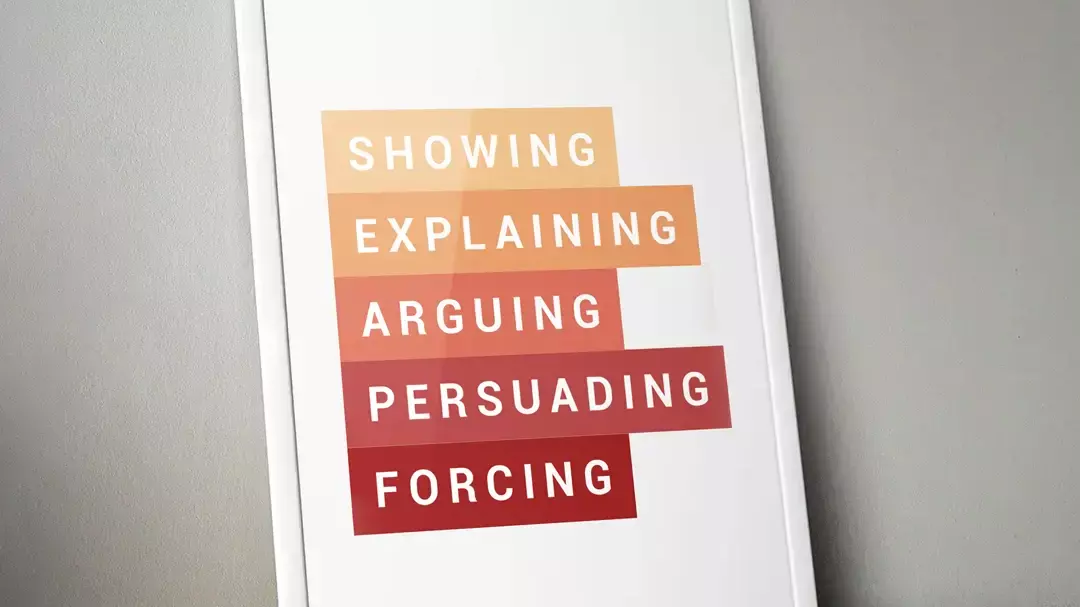









Decided by five
A communication proposal reaches the company. The owner sees it. Then the son or daughter who has been running sales for a few years. Then the sales director, the marketing manager and, often, someone from accounting who is credited with good taste. Each suggests a sensible change: a less vivid color, a more reassuring headline, a more traditional photo, a bigger product shot.
The final result displeases no one. And it no longer says anything.
The Sum of the Corrections
None of the changes, taken individually, is wrong. Each correction, taken on its own, is reasonable. It is their sum that is not.
The reason is that nearly all of them pull in the same direction: toward the middle. Whatever seems excessive is toned down, whatever seems risky is softened, whatever someone misses is added. But communication that gets noticed is, by definition, the kind that strikes someone around the table as “a bit much.” Shaving off that edge at every pass means arriving, by successive approximation, at an average. And the average is exactly what competitors produce too.
Who Judges, and by what Measure
There is a second, subtler effect. Each of the five judges by their own yardstick. The salesperson thinks of their most important customer. The owner thinks of the company’s history and how it has always presented itself. The thirty-year-old thinks of how it would look on social media. None of them is the audience the communication is meant for.
Each correction, taken on its own, is reasonable. It is their sum that is not.
Without anyone deciding it, the question stops being whether the proposal works for the people it is meant for and becomes whether it pleases the people sitting at the table. They are two different questions, often with opposite answers.
The Cost you Don’t see
The most obvious price is time. Revision rounds multiply, deadlines slip, the catalog goes to print just before the trade show instead of with the planned margin.
The less obvious price is higher. After a few rounds, whoever is proposing learns. They learn which solutions will be rejected and stop presenting them. They start bringing straight in the version that will get through, which is always the safest and rarely the best. The company keeps paying for creative work, but receives a proposal already pre-corrected for the objections it has learned to expect.
The question stops being whether the proposal works for the people it is meant for and becomes whether it pleases the people sitting at the table.
Listen to Everyone, decide with One
This does not mean shutting people out. The salesperson knows customers better than anyone, whoever runs production knows the product, the owner knows the meaning of what the company has become. This is valuable information, and a project that does without it is poorer.
The point is when it comes in. The right moment to gather input is the beginning, when it is decided what to communicate, to whom and with what goal. Not the end, when a proposal already built on those foundations is being judged. In the first case opinions become project material. In the second they become vetoes.
Input enriches a project. Scattered vetoes hollow it out.
Once the input is gathered, the decision belongs to one person, with a clear mandate and knowledge of the agreed goals. In family businesses it is often the owner, and that is perfectly fine: what matters is that it is one person, that this is made explicit and that the proposal is judged against the goals, not against their own taste or anyone else’s. Input enriches a project. Scattered vetoes hollow it out.
Listen to Many. Decide with One.